11
11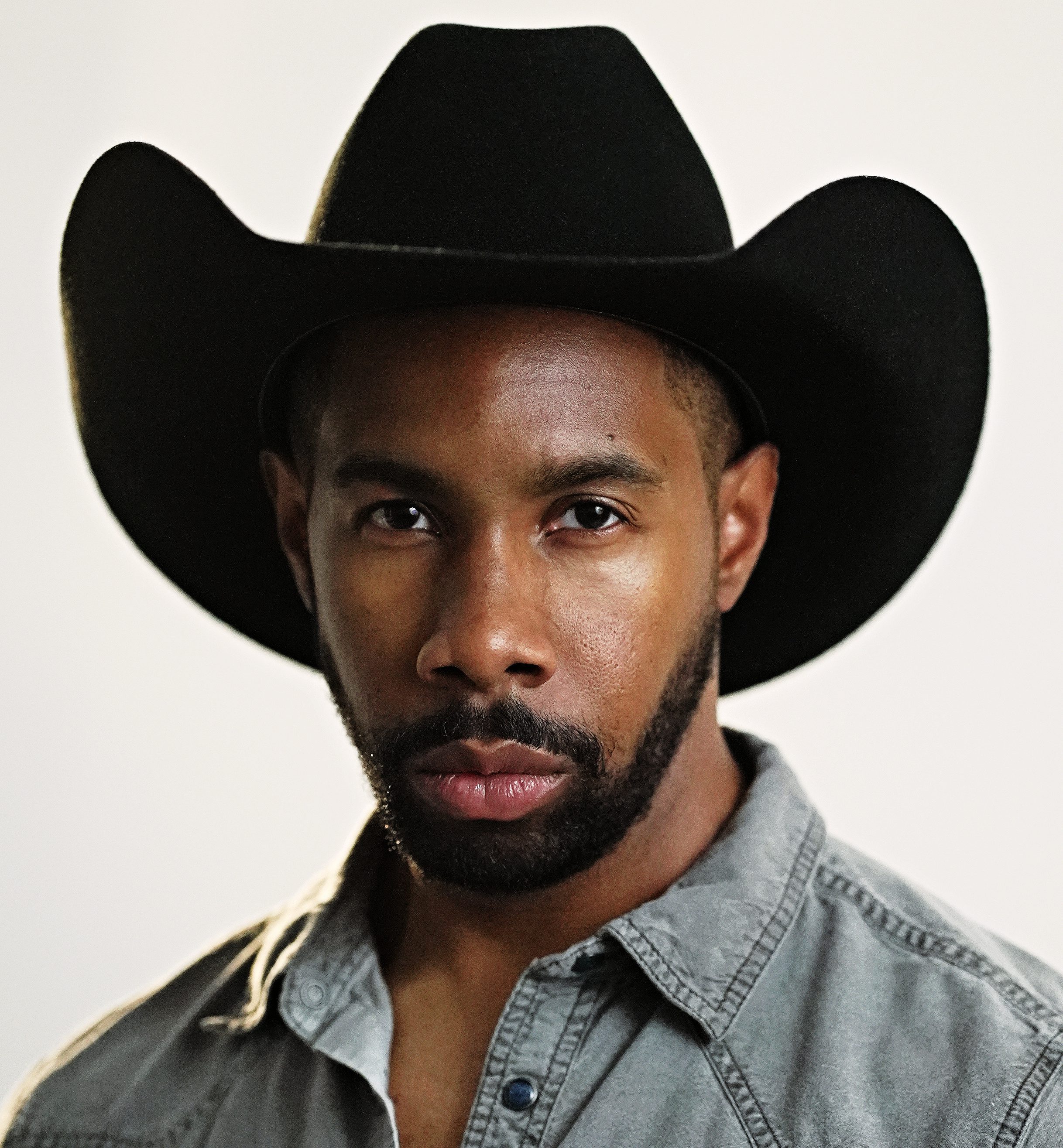
By Rob Hill
It’s a perfect 75-degree day in Los Angeles, the kind of day that makes the city feel honest again—blue sky, soft sun, the air warm without being thirsty. Up on a rooftop, where the noise drops just enough for you to hear your thoughts, AJ Lovelace—better known as Cowboy Lovelace—sits back in a patio chair like time owes him nothing.
The sun is doing that California thing—softly kissing his brown skin, catching the edges of his smile. AJ has the kind of presence that doesn’t announce itself. He doesn’t fill the room by talking. He fills it by being. Award-winning filmmaker. Quiet storm. The type of man who is seen, not heard—and still somehow sets the tone.
His black t-shirt is poppin’. A classic black cowboy hat sits perfectly on his head, not costume, not gimmick—more like signature. His boots look ready to wrangle any “bull” that decides to act brand new. And while most men carry permits for weapons, Cowboy Lovelace might need one for his arms.
“Ain’t that it though?” he says, tilting his hat with a confidence that feels earned, not performed.
He smiles again, taking in the rooftop view like it’s a ritual—clear skies, the city stretched out beneath us, Los Angeles doing what it does best: acting like a dream while quietly daring you to make it real.
And that’s the thing about AJ. He isn’t here to romanticize dreams. He’s here to actualize them.
Before we even get into the cowboy hat, the boots, the legend—AJ wants to talk about art.
Not art as trend. Not art as content. Art as calling.
“I feel like the thing about art is that there’s this beautiful space,” he says, “where craft, skill, passion—and precision—meet each other. They find a way to connect.”
He speaks like someone who has spent his life chasing that meeting point. Like someone who knows the difference between wanting attention and wanting mastery.
“And that unrelenting desire to pursue that,” he continues, “that’s when you know it’s your thing.”
AJ calls himself an actualizer, and he says it with a kind of quiet pride—like he’s naming his true job title.
Because he’s not the guy with “ideas” in the abstract. AJ is the guy with ideas that arrive fully dressed.
“I don’t get writer’s block,” he says. “I have the opposite. I call it writer’s flood.”
And when he says flood, he means it. AJ doesn’t just see the film—he sees the trailer, the poster, the rollout, the audience, the impact. He sees the billboard version of the moment before the moment exists.
“Not half-baked,” he says. “Top to bottom. Head to toe. Complete down to the packaging. Which audience needs to see it. What we look like on a billboard. What the trailer looks like. What the binding of the book looks like. Like… I have it locked in.”
What stops him isn’t imagination.
It’s the world’s usual limitations: manpower. budget. timing.
He laughs and calls it “fiscal lubrication,” because money makes things smoother. It’s easier to rent the space. Buy the outfit. Hire the extra hands. Bring the vision to life without having to fight for every inch.
But when he hits that traffic jam—when the vision is loud and the resources are quiet—AJ has learned how to cope without losing himself.
“I’ve had to find a way to turn up the radio,” he says. “I’ll turn myself onto other things that inspire me. And I’ll enjoy those things thoroughly without the need to also produce.”
But that peace never lasts too long.
“Because at the end of the day,” he says, “I still have that deep desire to make something exist.”
That’s the heartbeat of AJ’s artistry: not just expression, but existence. Not just thoughts, but proof.
“It might take me ten years,” he says. “It might take me fifteen years. But when I actualize that thing and it exists in the world, it’s going to be what I always saw—or better.”
There’s a question that hangs over creatives in 2025, especially in a city like this: why do so many talented people never finish?
AJ doesn’t hesitate.
“100%,” he says when asked if fear is the reason people stall. “I saw something once where somebody was like—there’s someone out there who is not better than you. They just believe in themselves more.”
And he’s right. Because we’ve all seen it—mediocre work catching fire while brilliant work stays trapped in a hard drive. Not because the brilliant work isn’t worthy, but because the mediocre work is at least moving.
AJ isn’t dismissing critique. He’s not saying fundamentals don’t matter. He’s saying the people who keep shooting eventually get better.
“They’ll keep firing the gun until they hit,” he says. “But if you never fire the gun, you’re not going to hit nothing.”
That’s AJ’s edge: he believes in the work enough to release it. Not recklessly—strategically, with care. But he’s not waiting for perfection to give him permission.
And it helps that his work—by design—isn’t about him.
“I feel really fortunate,” he says, “that my work is not about me. And it hasn’t been for a very long time.”
That does a few things. It keeps him from being self-indulgent. It forces him to elevate the craft. And it frees him from the kind of insecurity that keeps artists silent.
“I’m never too paralyzed by someone’s opinion to not produce,” he says. “And I’m never too paralyzed by perfection to produce.”
Slowing him down is possible.
Stopping him? Not really.
People love to romanticize the artist as this mysterious loner, tucked away in a studio, birthing brilliance through suffering.
AJ tells the truth: most of his work is solitary.
“Most of my work is solitary,” he says. “There’s a very small percentage of it that’s with a lot of people. It’s with a lot of people for a very short space of time. And then it’s me again.”
And here’s where it gets real: AJ is an extrovert.
“I get energy from exchanging energy with others,” he says. “Silence can be restorative… but when it goes on too long, it hermitizes me.”
That’s the deceptive part: the world sees the finished film, the premiere, the applause. But the actual creation? That’s hours alone, days alone, seasons alone. It’s you and the work, and the voice in your head that can either build you or bury you.
“And then it can put me in my head all the time,” he says. “Because the fantasy in the world that’s up there, I can create that endlessly.”
But it always comes back to one desire:
“I want to share it,” he says. “I want community around the thing. I want conversation.”
That’s why the work matters. It’s not just product. It’s connection.
AJ didn’t arrive at filmmaking in a straight line. He arrived like most artists who become inevitable: by following the thread that kept tugging on his spirit.
“I started painting very early—like four years old,” he says. “You know the little watercolor Crayola set your parents get you? That was me.”
He laughs, remembering childhood chaos—walls mistaken for canvas, messy experiments, that early hunger to create before he even had words for what he was doing.
But one thing shaped him early: his mother’s encouragement wasn’t abstract. It was practical.
“If I said I was interested in something,” he says, “my mother would find a way to make it happen. Not just talk—practice.”
Painting lessons started around six. By seven, he was getting portrait commissions.
And then, around nine or ten, AJ wrote a poem about horses and freedom. A teacher entered it into a contest without telling him.
It did well.
“She came back with good news,” he says, “and suddenly I understood—oh, I can do this thing. Whatever this thing is.”
That’s when art stopped being hobby and started becoming identity.
Around that same time, AJ bought a little Nikon digital camera with money he’d earned. It wasn’t about being “a photographer” at first. It was about supporting the painting—capturing subjects so they didn’t have to sit for hours.
But the camera taught him something painting couldn’t.
Composition. Mood. Framing. Light.
He remembers always toggling to black and white—something about stripping down color to reveal the truth underneath.
Then he bought a video camera—Canon HV10, if memory serves—and suddenly film began to percolate.
At the same time, he thought he’d become an author. As a kid, he saw a family friend making a living writing, and his mind connected it to success.
So he imagined novels—complete with illustrations—because AJ has always believed the written and the visual belong together.
But high school shifted everything.
A presentation introduced him to performing arts—singing, dancing, acting. A demo video showed him a world where feelings had somewhere to go five days a week.
And it moved him.
“I was blown away,” he says. “I was like—wait, I can do this. There’s a place that I can put these feelings I’m having.”
He typed up a script. Got teachers to check it. Tried to start an audio-visual club. Convinced friends to skip recess. It didn’t fully launch—but the trajectory did.
And then the line that feels like a thesis for his whole life:
“My corny joke has been,” he says, “I used to paint with brushes. Now I paint with cameras.”
So where does Cowboy Lovelace come from?
“The best part about that,” AJ says, “is my last name means outlaw.”
Outlaw. Lawless. The mythology writes itself—until you realize it isn’t mythology at all. It’s lineage.
He grew up watching his father wear highway boots. His grandfather carried a cowboy aesthetic—dapper, magnetic, elegant. When his grandfather passed, AJ didn’t get to keep the clothing, but he kept something else:
The energy.
The presence.
The freedom.
Cowboy Lovelace is AJ’s homage. But it’s also his statement.
“Cowboys are Black and brown, historically,” he says. “Preserving that history matters.”
His parents are Jamaican. The cultural imprint of Black cowboys, Buffalo Soldiers, and freedom mythology runs deep. And for AJ, freedom isn’t a vibe—it’s an ethic.
It shows up in his storytelling.
“In continuing to be unafraid to be honest,” he says. “In confronting things in my own history through my art… and not being afraid to say the quiet part out loud.”
And then he says the part that hits hardest:
“Film is forever,” he says. “It’s undeniable.”
That’s why he does it.
Because once the truth is captured in frame, it can’t be unsaid.
When the conversation turns to Hollywood, AJ stays calm.
Because he’s never depended on the system.
“I have never been inside the system,” he says. “The system was not built for people like us.”
But here’s the pivot:
“Art always finds a way.”
He makes the distinction that every creative needs tattooed on their spirit: art and industry are not the same.
An industry can crumble.
Art does not die.
He’s critical of the way “content” has flattened the soul out of storytelling—turning creativity into a metric, a conveyor belt, a formula that benefits a small percentage of people while starving the rest.
“This is supposed to be a creative medium,” he says, “but it’s not being run by creative people.”
And that’s the conflict.
So his advice isn’t to chase the industry’s approval.
His advice is to keep making art and build community around it.
Because community is what keeps you human.
When I ask AJ what “handsome” means to him, he pauses like he respects the word too much to answer casually.
“I have a really interesting relationship with that word,” he says.
As a child, he remembers adults telling him he was handsome, and he didn’t understand it beyond “this is a compliment.” He said thank you because he was raised right.
But as he got older, he realized the word carried something deeper. It wasn’t just exterior. It was recognition.
“It sounded more concrete than someone being hot,” he says. “More substantial than sexy.”
To AJ, handsome is confidence—not arrogance, but commitment. It’s the way someone carries themselves when they love who they are and aren’t asking permission to exist.
Handsome is alignment.
Season two of Onyx is coming! Season Onyx of this web series won him several awards. He’s returning to photography with fresh reverence, inspired by the influence and encouragement of iconic photographer John Simmons.
He’s re-examining the still image—the power of a moment preserved.
And even as the world narrows its imagination, AJ is widening his.
“Even as other people’s perspective on art gets smaller,” he says, “our vision should continue to grow.”
Because we’re always moving forward.
“We’re always going to be in the future,” he says.
And Cowboy Lovelace?
He’s already there—hat tipped, boots planted, camera in hand—painting freedom into frame.